01
Planning & work orders
Release, schedule and track every job — tied to the machine, the part and its bill of materials from the start.
- Work-order lifecycle & batches
- Machine & shift scheduling
- Live job status on the floor
AMP · Autonomous Manufacturing Platform
AMP is MARX8's manufacturing platform — a single system that plans, executes and learns from production. Work orders, real-time OEE (Overall Equipment Effectiveness), quality and maintenance, inventory and BOM (Bill of Materials) automation, and roles for multi-company teams, all connected to your machines.
What AMP does
AMP replaces the patchwork of spreadsheets, whiteboards and disconnected tools with a single real-time system — from the moment a job is planned to the intelligence that comes back out.
Release, schedule and track every job — tied to the machine, the part and its bill of materials from the start.
Live machine status, downtime and OEE — availability, performance and quality — the moment it happens.
Inspections tied to the exact work order and machine, with preventive maintenance scheduling and full traceability.
Complete a work order and AMP auto-consumes raw material and books finished goods — no manual stock entry.
Admin, Supervisor and Operator access, with each company's data isolated and enforced on the server — not just hidden.
New · AMP Fleet
AMP Fleet puts every mover on your floor — AMRs, AGVs, tugs and forklifts — on one live map, and lets the plant dispatch them itself. Because AMP already runs the MES, it knows the moment a batch finishes or a machine needs material — so most moves are raised and dispatched with no human input at all.
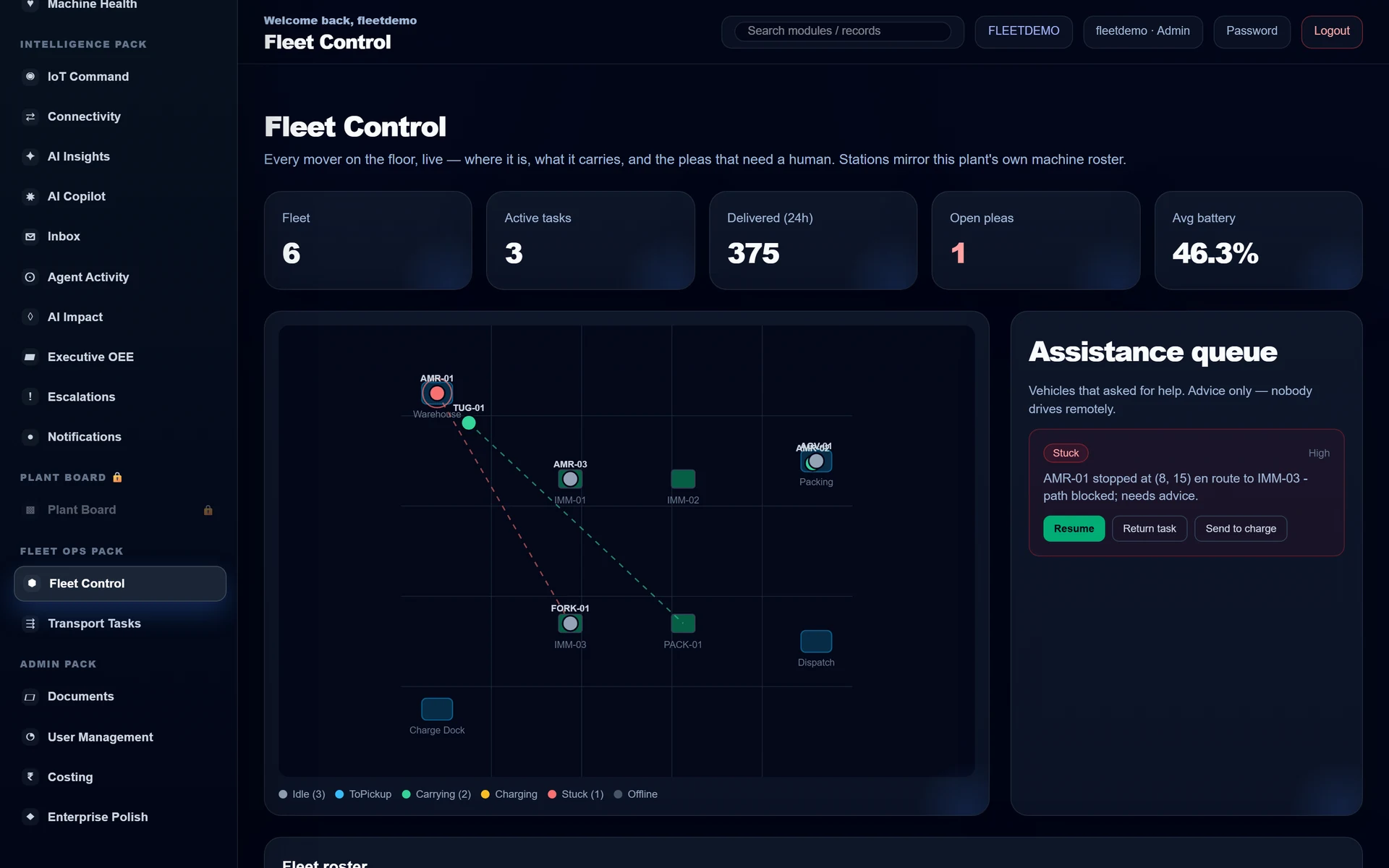
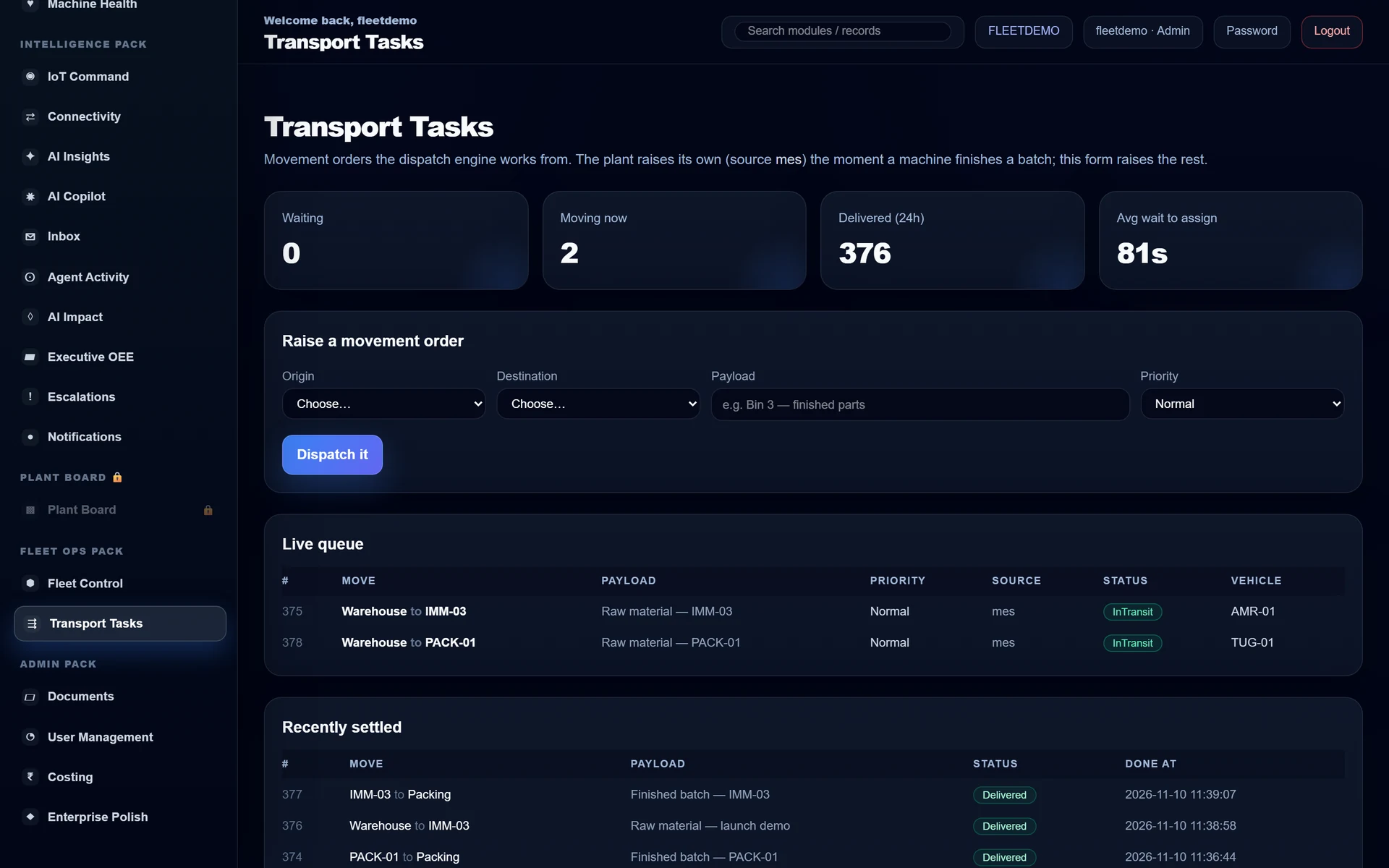
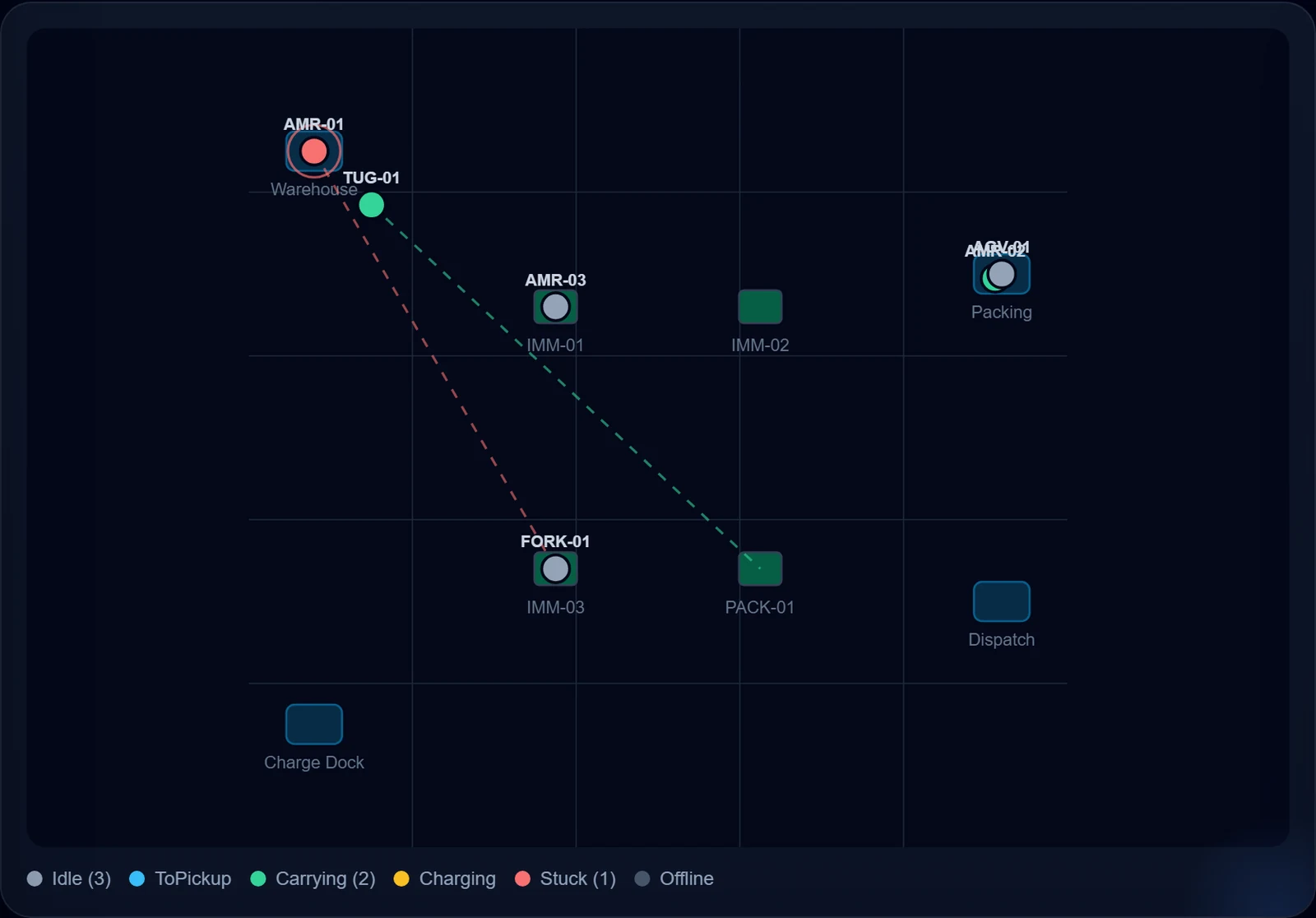
Finished batch? Material running low? The MES raises the movement order and AMP assigns the nearest healthy vehicle — most urgent first, never one low on battery.
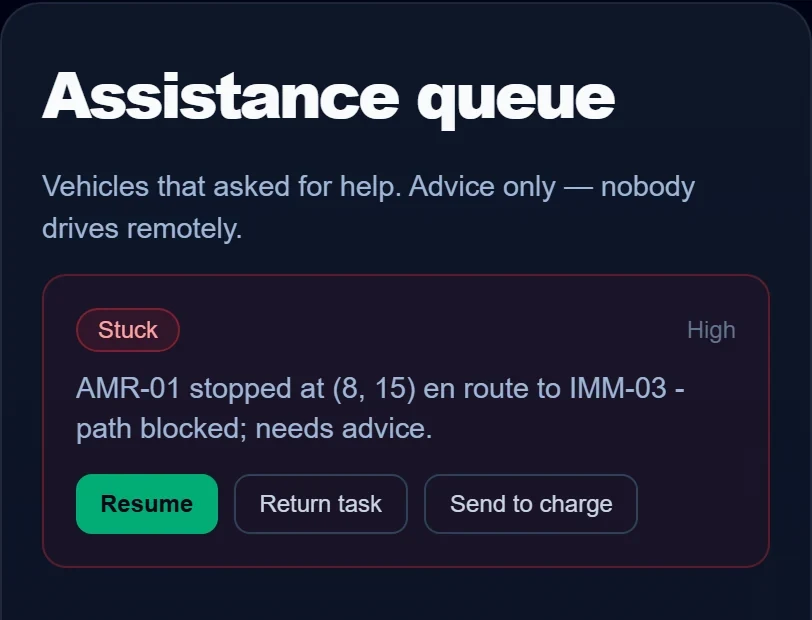
A confused robot asks for help, and a person answers from a closed set — resume, return the task, or send it to charge. The same fleet-response model the big autonomy operators run.
The built-in simulator behaves exactly like a real fleet adapter, so your team runs the workflow now and real vehicles (MiR, VDA 5050) plug in later without changing a thing they see.
What you get, and when
A clear split between what ships today, what's on the Enterprise plan, and where AMP is heading next.
Direction we're building toward — not yet available.
How it connects
Nothing is an island. A single work order ripples through the whole plant automatically — complete a job and AMP consumes raw material, books finished goods, flags low stock for reorder, and updates OEE. No re-keying, no gaps.
The landscape
"ERP", "MES", "smart factory", "autonomous factory" — these aren't competing products, they're a maturity ladder. Here's what each layer does, and where AMP sits today versus where it's heading.
Enterprise Resource Planning runs the business side: finance, procurement, sales orders, materials planning and headcount. ERP knows what to make and the money around it — but not what's happening on the machines, minute to minute.
Manufacturing Execution System — runs the shop floor in real time: work orders, machine status, OEE, downtime, quality and traceability. MES is the bridge between the ERP's plan and the physical line, the layer that knows what every machine is doing right now. This is AMP's core.
Manufacturing Operations Management — a wider umbrella than MES: production, quality, maintenance, inventory and labour coordinated as one operation. AMP already spans quality, maintenance, inventory and reorder, so it reaches into MOM territory.
The Industry 4.0 baseline: every machine, sensor and system connected and streaming data through IIoT, edge and cloud. You can see everything live — but people still make the calls. AMP's real-time, PLC-connected data layer puts a factory here.
The factory doesn't just show data, it acts on it. AI schedules, reroutes and triggers responses with minimal human input. AMP's automatic escalations are the first steps up this rung.
The plant learns from its own history and improves continuously — models that sharpen with every batch, predicting quality and failures before they happen. This is where AMP's data foundation is built to go next.
The end state: production runs with the lights off — robotics, automated cells and software running the line end-to-end, with little or no one on the floor. The destination the whole ladder points toward.
AMP starts as an MES / MOM and is engineered to climb — from connected, to autonomous, to cognitive. You can start capturing value today and grow into the future without ripping out and replacing. That's the whole point of the name: Autonomous Manufacturing Platform.
FAQ
Straight answers on what ships today, how AMP fits your systems, and how to see it on your floor.
The five core modules — planning & work orders, real-time OEE & monitoring, quality & maintenance, inventory & BOM automation, and roles & multi-company — are available today. AMP Fleet, executive OEE dashboards, IoT command, multiple plants and on-premise deployment are Enterprise options. AI-driven scheduling and self-learning (cognitive) manufacturing are on the roadmap — the direction we're building toward, not yet available.
No — they do different jobs. Your ERP runs the business side (finance, procurement, sales orders and planning); AMP is the MES/MOM layer that runs the shop floor in real time — work orders, machine status, OEE, quality and inventory. They sit on neighbouring rungs of the same maturity ladder and complement each other.
AMP connects to shop-floor equipment over industrial protocols including OPC UA, Modbus and Siemens S7, so machine status, downtime and OEE come straight from the line. Tell us what you run and we'll confirm exactly what's possible for your setup.
Yes. AMP is multi-company by design — each company's data is isolated and enforced on the server, not just hidden in the interface — with role-based access for Admin, Supervisor and Operator.
No. AMP Fleet includes a built-in simulator that behaves exactly like a real fleet adapter, so your team can run the full workflow before a single robot arrives. Real vehicles (for example MiR, or VDA 5050-compatible AMRs) plug in later without changing what your team sees.
Request a demo and we'll show you AMP with sample data, then map the fastest path from spreadsheets to a live, connected operation. Email us for a demo or explore the hosted app at app.marx8.com; on-premise deployment is available as an Enterprise option, agreed in your proposal.
Tell us about your machines and what you track today. We'll show you AMP with sample data and map the fastest path from spreadsheets to a live, connected operation.